Welcome to the 1926 SAT.
The 1926 SAT marked the debut of the SAT, influenced by psychologist Carl Brigham, who previously worked on developing aptitude tests for the Army during World War I. This version of the SAT was seen as a psychological test, drawing inspiration from the Army Alpha intelligence tests. Additionally, Subtests 1, 2, 4, 5, and 7 were adapted from Brigham's 1925 Princeton Test.
The first SAT was administered on June 23, 1926, to 4,829 boys and 3,211 girls at various colleges across the U.S. Designed to assess learning aptitude rather than academic knowledge, the SAT provided a standardized measure applicable to a diverse range of high school students for college admissions.
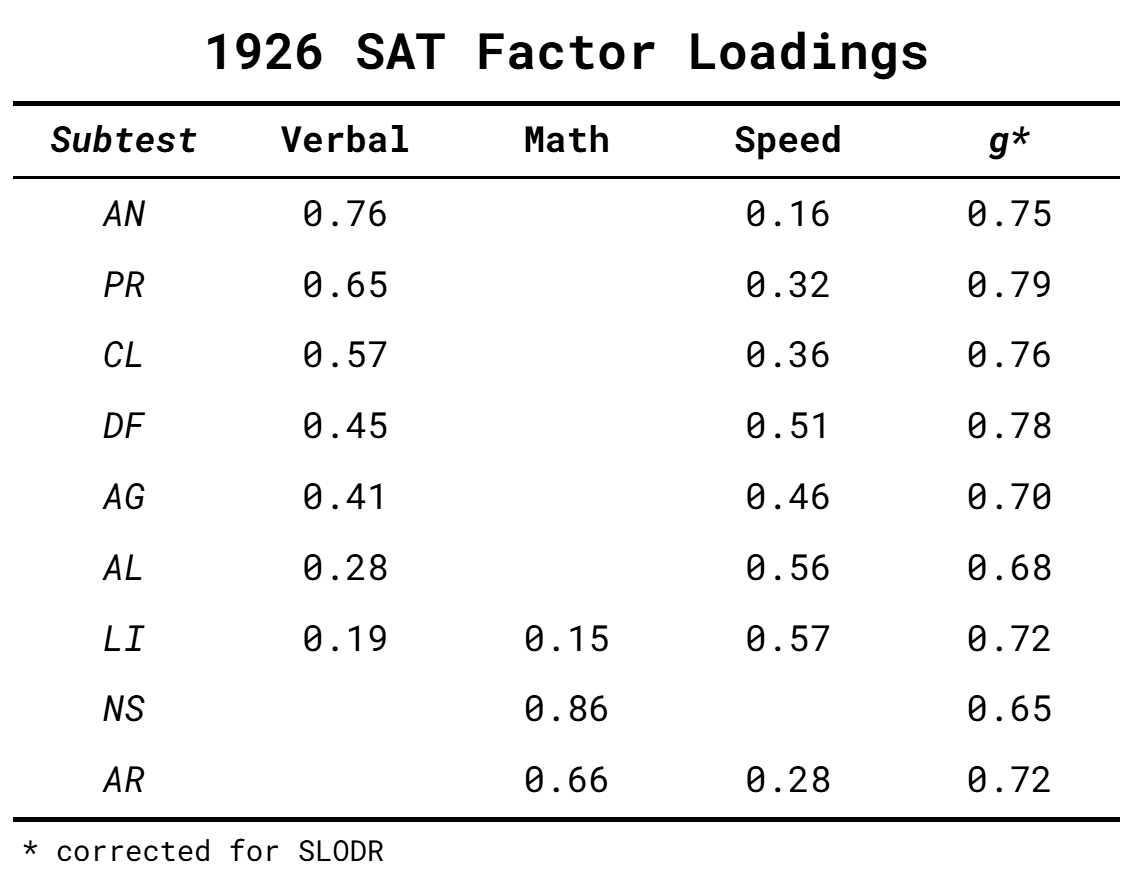
This test has been factor analyzed and has been found to load ~0.89 on g, with a strong split-half reliability and Cronbach's α of 0.98.
This test has 9 subtests and will take 98 minutes total to take.
This test consists of nine sub-tests, all of which can be taken for free below. When you finish, the overall Full-Scale, Quantitative, and Verbal composites can be viewed in your dashboard.
| Subtest | Factor | Items | Time Limit | |
|---|---|---|---|---|
| Definitions | V | 33 | 9 min | Begin |
| Arithmetic | M | 20 | 8 min | Begin |
| Classifications | V | 40 | 6 min | Begin |
| Artificial Language | V | 20 | 9 min | Begin |
| Antonyms | V | 50 | 10 min | Begin |
| Number Series | M | 25 | 9 min | Begin |
| Analogies | V | 40 | 6 min | Begin |
| Logical Inferences | M | 40 | 10 min | Begin |
| Paragraph Reading | V | 50 | 30 min | Begin |
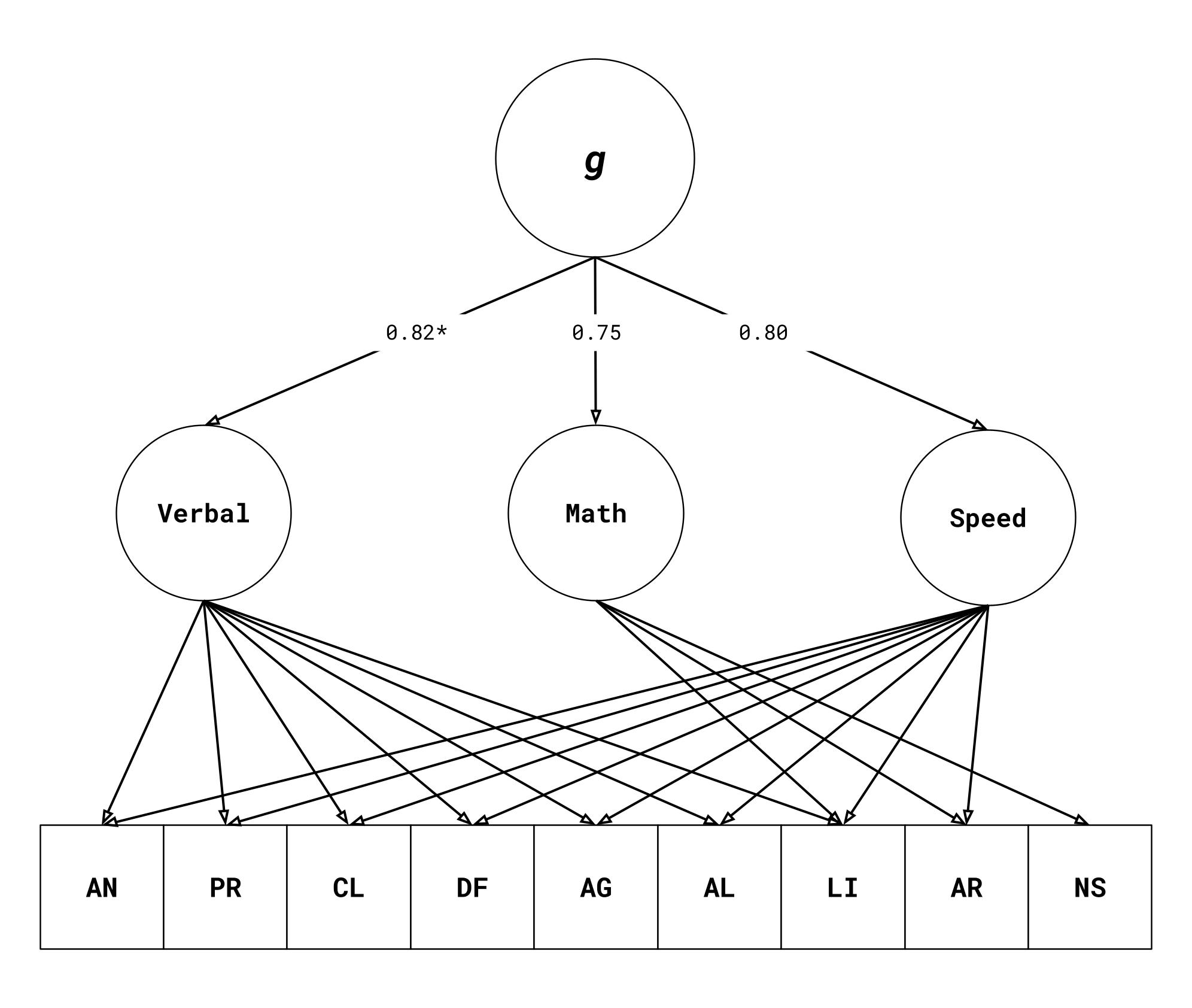
The 1926 SAT is modeled as a hierarchical structure, with its nine subtests loading onto three broad factors, which in turn load onto a general factor (g). This model was found by factor analyzing the 1926 SAT along with CORE, GRE, and AGCT, and showed very strong fit (CFI = .965, TLI = .960, RMSEA = .011, SRMR = .049). A joint factor model between the 1926 SAT and CORE found the general factors to be isomorphic with one another as well.