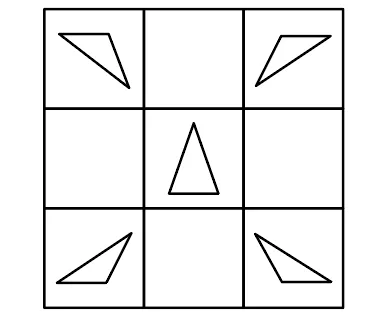
1) From top to bottom, as well as from left to right it seems that the shapes rotate 90 degrees each time. Suppose that the shapes are in 2D format in the 1st column (middle shape) would be just a line ---, in the 2nd column the 2 missing shapes would also be horizontal lines, same logic in the third column. But lines are not "shapes" so this type of thinking cancels out, even though it is a somewhat valid pattern.
2) The other pattern would be to add first and last shapes on each column, in order to produce the middle shape. For example in the first and last column the shape would be a parallelogram (which is composed of the 2 added triangles), whereas in the 2nd column the missing shapes would be (2) left/right triangles.
3) The third pattern is if we assume that the above process happens not in columns but in rows, so the parallelograms would appear in first and third row (for the 2nd items), whereas in the 2nd row the missing shapes would be the left/right triangles that compose the middle triangle.
Most likely it's none of them and it's a completely different pattern that I miss!
Vincenzo
@vixent
3 months ago
My solution. So the central figure is clearly mirrored, and depending on how you change the direction of view, the way the figure stretches will also change. In the second column of the first row, there will be a triangle that is more elongated at the tip and will point downward like the adjacent figures. They are similar to those at the corners, except that they will point toward the center in an elongated manner in all the missing blocks.

forum Comments (2)
Sign in to leave an answer.
1) From top to bottom, as well as from left to right it seems that the shapes rotate 90 degrees each time. Suppose that the shapes are in 2D format in the 1st column (middle shape) would be just a line ---, in the 2nd column the 2 missing shapes would also be horizontal lines, same logic in the third column. But lines are not "shapes" so this type of thinking cancels out, even though it is a somewhat valid pattern.
2) The other pattern would be to add first and last shapes on each column, in order to produce the middle shape. For example in the first and last column the shape would be a parallelogram (which is composed of the 2 added triangles), whereas in the 2nd column the missing shapes would be (2) left/right triangles.
3) The third pattern is if we assume that the above process happens not in columns but in rows, so the parallelograms would appear in first and third row (for the 2nd items), whereas in the 2nd row the missing shapes would be the left/right triangles that compose the middle triangle.
Most likely it's none of them and it's a completely different pattern that I miss!