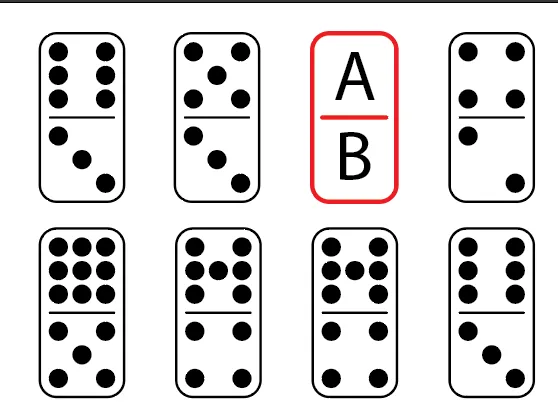
Let's call U the upper rectangles and L the lower rectangles. All the L's arise from this operations: let's take for example the 1st column, where U1=6, U2=3 and L1=9, L2=5. I see that L1 = U1 + (U1 - U2) = 6 + (6 - 3) = 9 and L2 = U2 + (U1 - U2) - 1 = 3 + (6 - 3) - 1 = 3 + 3 - 1 = 5. Every single column arises from these operations...I don't see another pattern for now, so my guess is that A = 5 and B = 3, just like the column in the left (of AB).
Specifically L1 = A + (A - B) = 5 + (5 - 3) = 5 + 2 = 7 and L2 = B + (A - B) - 1 = 3 + (5 - 3) - 1 = 3 + 2 - 1 = 4.
JC
@jcn
5 months ago
There is probably a misfortunate pattern in every 3 fully given columns: 2A = B+C and D = A - 1, which would give 53.
I was working out L1 the same way as Konn, but did not think the columns could be taken as random numbers in isolation.
Given L2 in columns 1 and 3 matched U1 in columns 2 and four, I thought there might be a rule that this number carries over.
On that basis, the only combination that would make the L1 calculation hold would be 41. But that was not correct, and to be fair, did not incorporate an explanation for the L2 figures.
chrstn
@chrstn
4 months ago
Call all dominoes in row 1 with 'U' (U1, U2, U3, U4) and all dominoes in row 2 with "L" (L1, L2, L3, L4).
Then to differentiate between the upper and lower halfs of each dominoe include a "1" or a "2" after the column value (U12 means the lower half of row 1 column 1)
Ux1 = Lx2 + 1. Therefore A = 5
Ux2 = (Ux1/)2 then rounded to the nearest whole number ----> U11/2 = 3 (rounded is still 3) & U21/2 = 2.5 (rounded becomes 3)
So,
U31 = 5
U32 = 3
A=5
B=3
carp
@vinkhassom
3 months ago
from what i can see:
bottom domino two numbers multiplied give the top domino number read bottom to top, however the very bottom number of the bottom dominos alternates +1 , -1 prior to multiplication
lowk cute puzzle tho heh
carp
@vinkhassom
3 months ago
from what i can see:
bottom domino two numbers multiplied give the top domino number read bottom to top, however the very bottom number of the bottom dominos alternates +1 , -1 prior to multiplication (therefore 3x7=21, A=1; B=2)
lowk cute puzzle tho heh
L. Ar
@matthewa
1 month ago
A=8
B=4
Kaboke
@kaboke
1 month ago
A = 4; B = 2?
The "numerator" of the dominos horizontally-listed above has a repeating sequence of +3 to the "numerator" of the dominos horizontally-listed below, and then +2 for the next one, using the same transformation; the "denominator" of the dominos uses the same transformation between the ones above and the ones below, except that it now first adds +2, and then +1.
I'm not sure, although I'll leave this as my final answer

forum Comments (10)
Sign in to leave an answer.
Specifically L1 = A + (A - B) = 5 + (5 - 3) = 5 + 2 = 7 and L2 = B + (A - B) - 1 = 3 + (5 - 3) - 1 = 3 + 2 - 1 = 4.
Given L2 in columns 1 and 3 matched U1 in columns 2 and four, I thought there might be a rule that this number carries over.
On that basis, the only combination that would make the L1 calculation hold would be 41. But that was not correct, and to be fair, did not incorporate an explanation for the L2 figures.
Then to differentiate between the upper and lower halfs of each dominoe include a "1" or a "2" after the column value (U12 means the lower half of row 1 column 1)
Ux1 = Lx2 + 1. Therefore A = 5
Ux2 = (Ux1/)2 then rounded to the nearest whole number ----> U11/2 = 3 (rounded is still 3) & U21/2 = 2.5 (rounded becomes 3)
So,
U31 = 5
U32 = 3
A=5
B=3
bottom domino two numbers multiplied give the top domino number read bottom to top, however the very bottom number of the bottom dominos alternates +1 , -1 prior to multiplication
lowk cute puzzle tho heh
bottom domino two numbers multiplied give the top domino number read bottom to top, however the very bottom number of the bottom dominos alternates +1 , -1 prior to multiplication (therefore 3x7=21, A=1; B=2)
lowk cute puzzle tho heh
B=4
The "numerator" of the dominos horizontally-listed above has a repeating sequence of +3 to the "numerator" of the dominos horizontally-listed below, and then +2 for the next one, using the same transformation; the "denominator" of the dominos uses the same transformation between the ones above and the ones below, except that it now first adds +2, and then +1.
I'm not sure, although I'll leave this as my final answer