Questions:
The questions have been arranged in increasing order of difficulty, based on preliminary analyses. The last questions are extremely challenging, so it is advisable to focus on the easier ones first.
Numeric answers:
Provide numeric answers as numbers only (not in degrees or in radians).
Dual answers:
For questions requiring two different answers, enter each answer in the designated separate boxes.
Multiple choice:
Select only one answer from the provided options for each multiple-choice question.
Paraphernalia:
You are not allowed to use anything to help you. Paper, search engines, calculators, AI, and so on are not allowed on this section.
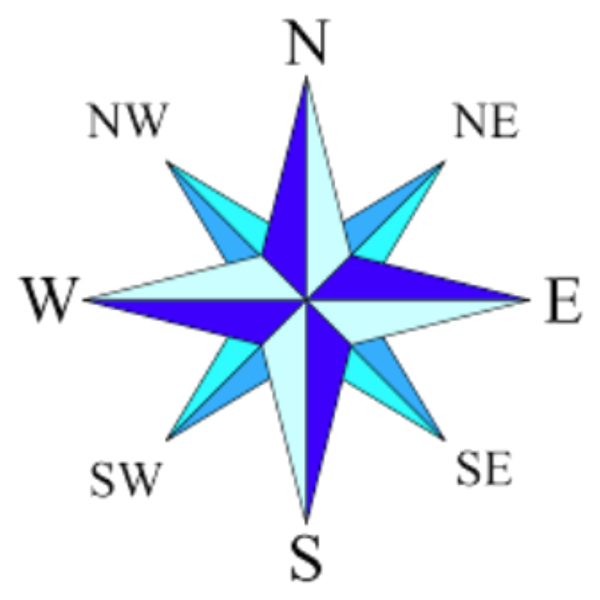
Reminder on cardinal directions:
How many sides does a square have?
Answer:
You are looking South. You turn to your right. Which direction is in front of you?
Answer:
How many faces does a cube have?
Answer:
You are looking South. You do half a turn to your left. Which direction is in front of you?
Answer:
How many perfectly flat (i.e. non-curved) faces does a cylinder have?
Answer:
You are looking East. You turn to your right. Which direction is behind you?
Answer:
If two squares of the same size are perfectly joined by gluing them together along one side, what shape will they form?
Answer:
You are looking North. You turn left, then you turn right twice. Which direction is in front of you?
Answer:
If you perfectly join two equilateral triangles of the same size by gluing them together along one of their sides, how many outer sides do you get?
Answer:
You are looking West. You turn right, then you turn left twice. Which direction is on your right?
Answer:
If you cut a rectangle into three equal horizontal strips, then into two equal vertical strips, how many rectangles of the same size and clearly visible are there in the large rectangle?
Answer:
You are looking East. You turn left twice, then you turn right one and a half times. Which direction is in front of you?
Answer:
If you overlap two circles of the same size, how many distinct sections (which are not infinite) can you obtain at most?
Answer:
You are looking South. You turn to your right one and a half times, then you turn to your left. Which direction is behind you?
Answer:
If you divide a square into four smaller, equal squares, how many four-sided shapes will there be in the larger square, including the original?
Answer:
You are looking North. You turn right twice, then you turn left two and a half times. Which direction is on your right?
Answer:
Given a cube with full-length sides, how many cubes with half-length sides can it hold without them overlapping?
Answer:
You are looking North-East. You turn left twice, then you turn around behind you and turn right. Which direction is in front of you?
Answer:
If you fold a square piece of paper along one diagonal, then along the other diagonal, what shape will emerge when you unfold the paper, and how many?
Answer:
You are looking East. You turn right two and a half times, then you turn left once, then you look back. Which direction is on your left?
Answer:
Given a square, if you cut it three times using straight lines that can be rotated, how many distinct sections (which are not infinite) can you get at most?
Answer:
Noa is to the South of Maëlys, Maëlys is to the East of Victor, Victor is to the South-East of Pauline. In which direction is Pauline from Noa?
Answer:
An equilateral triangle is folded so that one vertex lands exactly on another vertex, creating a crease. It is then unfolded. Next, it is folded so that the remaining vertex lands exactly on the midpoint of the opposite side, creating a second crease. After unfolding, how many triangles are formed in total inside the original triangle, including the original triangle itself?
Answer:
Claire is looking North-East. She takes five steps forward, turns left one and a half times and then takes about three and a half steps forward. In which direction is her starting point?
Answer:
If you overlap two triangles of the same size, how many distinct sections (which are not infinite) can you obtain at most, assuming you can rotate them freely?
Answer:
The market is to the North-East of the town hall, the town hall is to the South of the church, the church is to the West of the market, the greengrocer is to the North of the market. In which direction is the town hall from the greengrocer?
Answer:
If you fold a rectangular sheet of paper in half along each side, successively without unfolding the previous fold, i.e. a total of four times, what shape will emerge when you unfold the sheet at the end, and how many?
Answer:
You leave your house looking East. You turn right and walk twenty meters, then you turn left and walk another twenty meters, then you turn left again and walk forty meters. In which direction is your house?
Answer:
If you overlap two squares of the same size, how many distinct sections (which are not infinite) can you obtain at most, assuming you can rotate them freely?
Answer:
You are looking North. Nathan is in front of you, Yassine is on your left, Julie is on your right, Esteban is behind you? You turn twice to your right, then once to your left, then three times to your right. After all these rotations, who is behind you?
Answer:
A cube is painted on all six sides and then cut into 125 smaller cubes (5×5×5). When it is reassembled, what is the number of smaller cubes with exactly two of the original faces painted?
Answer:
You are in a house, with an empty plot in front of it, looking North. The house is to the left of a building, the building is to the North of a shop, the shop is to the right of a school, the school is to the East of a bookshop. In which direction is the empty slot from the school?
Answer:
Given five lines drawn inside a circle, what is the maximum total number of intersection points, including intersections with the circle?
Answer:
You have a white cube with fives sides, each painted a different color. The front face of the cube is yellow, the back face is blue, the top face is green, the left face is blue and the right face is yellow. You turn the cube once to the right (counterclockwise looking top) on the vertical axis, then once forwards. What color is now on the top face?
Answer:
If you interlace four cubes of the same size without turning them, how many distinct volumes (which are not infinite) can you obtain at most?
Answer:
You have a white cube with five sides, each painted a different color. The front face of the cube is green, the back face is red, the top face is yellow, the left face is blue and the right face is purple. You turn the cube once to the left (clockwise looking top) on the vertical axis, then twice forwards. What color is now on the top?
Answer:
A cube of length (2×2×2) is made up of different shapes placed one inside the other. There are 2 L-shaped pieces of length (2×2) and 2 cube-shaped pieces of length (1×1×1). Each piece may be freely rotated before placement, but pieces may not overlap. Two arrangements are considered different if the positions of the pieces inside the cube differ; arrangements that are related by a rotation or reflection of the entire cube are counted as different. How many possible arrangements of the pieces making up the cube would enable it to retain its size and shape?
Answer:
The towns of Ridge, Meadow and Crest are linked. Another town, Haven, is linked to Meadow and Ridge, and only to those two. Thomas has to make a journey that starts in Crest, ends in Crest and takes him along 4 roads. How many routes can Thomas take, bearing in mind that he can pass along the same road several times?
Answer:
A cube is made up of 27 small identical cubes (3×3×3). This cube is then cut into two equal parts by a plane that passes obliquely through the cube, thus dividing each small cube it goes through into two halves. This oblique plane is parallel to one of the diagonals of the front face and one of the diagonals of the back face, but it does not pass through the edges of the large cube but two. How many small cubes are partially cut by the plane?
Answer: