Do IQ Tests Only Measure Test-Taking Ability?
The claim that "IQ tests only measure how good you are at taking IQ tests" collapses when you put it up against a century's worth of predictive-validity research. Scores on IQ tests generalize far beyond just "IQ tests", anticipating how easily people learn, solve novel problems, and translate knowledge into real-world results.
IQ Test Validity in Education
Meta-analytic work spanning more than 82,000 students demonstrates that measures of general cognitive ability (g) are among the single strongest predictors of classroom achievement- outperforming emotional intelligence, socioeconomic background, and conscientiousness. Jensen points out in The g Factor:
The correlation of IQ with grades and achievement test scores is highest (.60 to .70) in elementary school, which includes virtually the entire child population and hence the full range of mental ability. At each more advanced educational level, more and more pupils from the lower end of the IQ distribution drop out, thereby restricting the range of IQs. The average validity coefficients decrease accordingly: high school (.50 to .60), college (.40 to .50), graduate school (.30 to .40).
Arthur Jensen, The g Factor, p. 278
g's relationship to scholastic performance is consistently positive and sizeable, but the strength of that relationship diminishes as you move up the educational ladder. This is not due to any change in the psychology of intelligence, but rather an expected statistical phenomenon known as "range restriction" (lower-IQ students exit the pipeline earlier, so the remaining pool becomes a specific, restricted sample, and correlations naturally shrink when variance on one variable is artificially limited). However, even the attenuated graduate-level correlations (.30-.40) are, by the standards of educational psychology, impressively high.
This is supported by a review of 70 independent samples by Kuncel, Hezlett, and Ones (2004), who report a corrected true-score correlation of r = .39 between scores on the g-loaded Miller Analogies IQ Test and cumulative graduate GPA, with an even higher r = .41 for first-year GPA; g correlations climbed to r = .58 for comprehensive exam scores and remained substantial for faculty ratings (r = .37) and supervisor-rated job performance (r = .41). These magnitudes comfortably sit in the mid-.30s to mid-.40s (and higher) range that characterize g's predictive power across educational settings (Kuncel, Hezlett, & Ones, 2004). As summarized by Professor Russel Warne in In the Know, higher IQ students "learn more rapidly, learn more efficiently, organize and generalize information more spontaneously, and make fewer errors than their average or below-average classmates" (Warne, 2020, p. 170).
Do IQ Tests Predict Job Performance?
The same pattern appears in employment. As shown in Figure 1 below, "scores on cognitive ability tests are strongly related to success in occupational training in both civilian and military jobs, with meta-analytic estimates ranging from the high .30s to 70s (Ones et al., 2005)" (Kuncel & Hezlett, 2010). Across every occupation, results from IQ tests are a reliable predictor of a range of outcomes, from job effectiveness and leadership success to judgments of creativity.
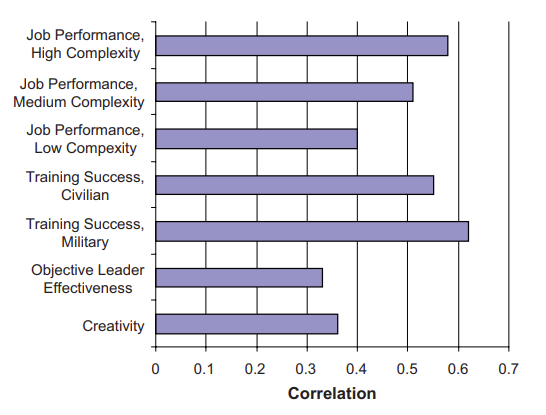
A landmark meta-analysis showed that, general mental ability correlates about r ≈ .58 with performance in the most complex jobs and r ≈ .23-.51 in less complex roles. An updated review of 100 years of selection research puts the mean validity of g at roughly .50 across all jobs (Strenze, 2007).
IQ, Income, and Long-Term Life Outcomes
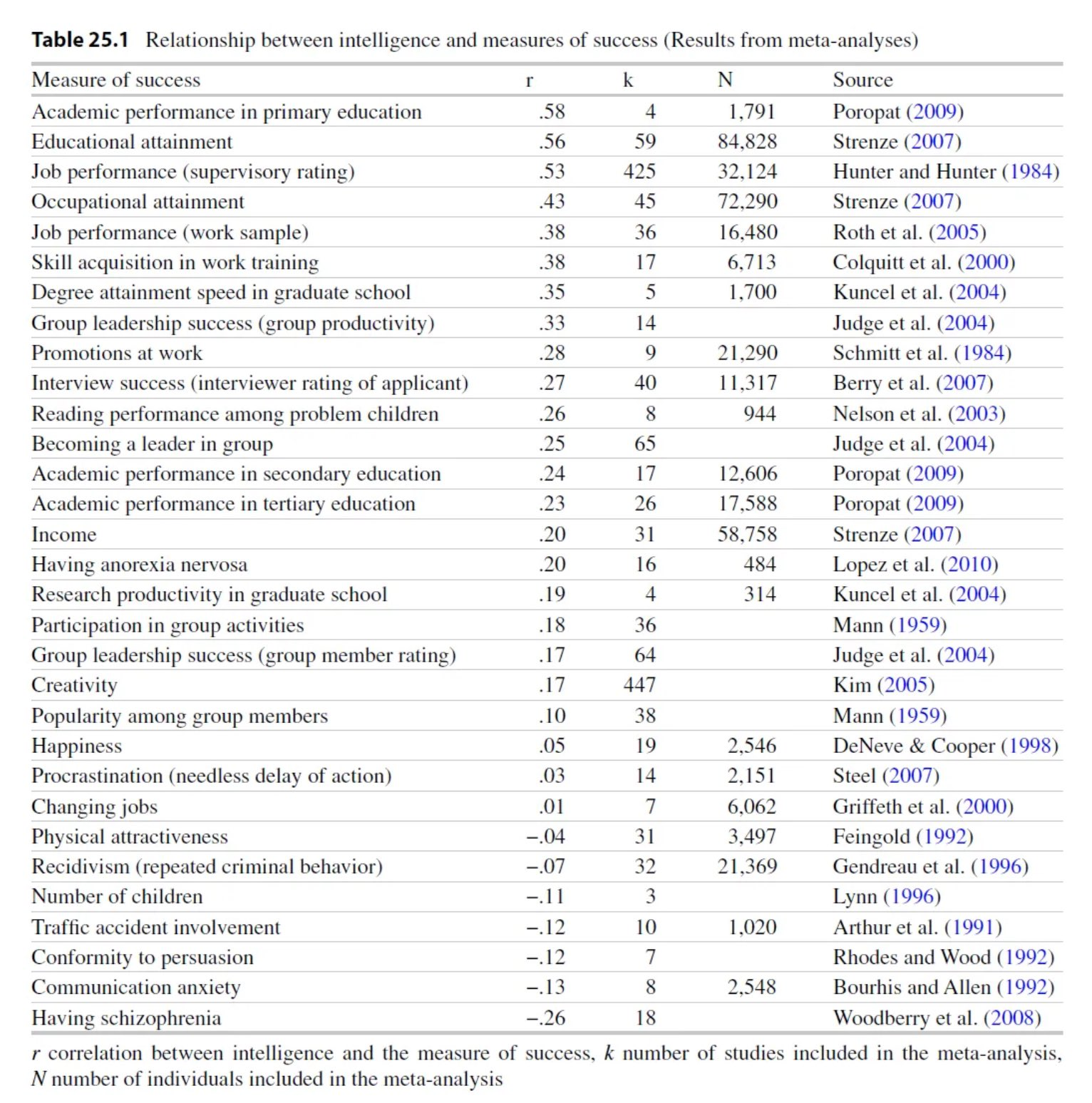
A longitudinal meta-analysis that followed more than 80,000 people from childhood or adolescence into established adulthood found that pre-19 IQ scores predict occupational status at r ≈ .45 and income at r ≈ .23 when outcomes are measured after age 29. Importantly, the same review confirmed the r ≈ .51 IQ to job performance correlation reported by Schmidt & Hunter, showing how early cognitive ability foreshadows how well people work. These translate into large economic gains for organizations because smarter employees master training faster, make fewer errors, and sustain higher productivity (Campbell & Knapp, 2001).
Beyond school and work, higher IQ in youth forecasts later income, occupational prestige and employment stability. Strenze's (2007) longitudinal meta-analysis found that childhood intelligence predicts educational attainment (r ≈ .56), occupational status (r ≈ .51) and income (r ≈ .40) decades later, even after family socioeconomic status is controlled.
So, Are IQ Tests Accurate and Valid?
A century of evidence shows that IQ tests do far more than predict success on other IQ tests. Meta-analyses covering tens of thousands of participants converge on the same story: the general cognitive factor g is one of the single best predictors of upper and lower level education, employment, life outcomes, and much, much more.
References
Campbell, J. P., & Knapp, D. J. (Eds.). (2001). Exploring the limits in personnel selection and classification. Psychology Press. https://doi.org/10.4324/9781410600240
Jensen, A. R. (1998). The g factor: The science of mental ability. Praeger. https://arthurjensen.net/wp-content/uploads/2020/04/The-g-factor-the-science-of-mental-ability-Arthur-R.-Jensen.pdf
Kuncel, N. R., & Hezlett, S. A. (2010). Fact and fiction in cognitive ability testing for admissions and hiring decisions. Current Directions in Psychological Science, 19(6), 339–345. https://gwern.net/doc/iq/2010-kuncel.pdf
Kuncel, N. R., Hezlett, S. A., & Ones, D. S. (2004). Academic performance, career potential, creativity, and job performance: Can one construct predict them all? Journal of Personality and Social Psychology, 86(1), 148–161.
Strenze, T. (2007). Intelligence and socioeconomic success: A meta-analytic review of longitudinal research. Intelligence, 35(5), 401–426. https://doi.org/10.1016/j.intell.2006.09.004
Strenze, T. (2015). Intelligence and socioeconomic success: A study of correlations, causes and consequences (Doctoral dissertation, University of Tartu). University of Tartu. https://dspace.ut.ee/server/api/core/bitstreams/6ea26618-56b2-43a0-8e4a-2586d117cac9/content
Warne, R. T. (2020). In the know: Debunking 35 myths about human intelligence. Cambridge University Press. https://doi.org/10.1017/9781108593298
Comments
Sign in to leave a comment.
No comments yet. Be the first to comment!